Brand Collaboration vs. Traditional Licensing: When to Use Each
Julie Brown
August 13, 2026
In today’s marketplace, brands have more options than ever to extend their reach, create consumer excitement, and unlock new revenue streams. Two of the most common approaches are brand collaborations and traditional outbound licensing. Each approach serves different business objectives and requires different strategies to be successful.
Understanding when to use each approach—and when a combination of both may be appropriate—can help brands maximize impact while staying true to their long-term goals.
Collaborations are best for awareness, testing, and cultural relevance. Traditional licensing is best for sustainable revenue and category expansion. Many top brands use both. Here’s what you need to know.
The Rise of Collaboration
Over the last decade, brand collaborations have become a powerful way to generate attention, engage new audiences, and create cultural relevance. From unexpected pairings to limited-edition product launches, collaborations can create buzz that traditional marketing often struggles to achieve.
At their best, collaborations bring two brands together to create something neither could achieve independently. They tap into shared audiences, complementary strengths, and mutual value creation.
But not every collaboration is strategic.
Many generate headlines without generating meaningful business results. The most successful collaborations are built on clear objectives, strong brand alignment, and a shared vision for success.
When a Brand Collaboration Makes Sense
Brand collaborations are often the right choice when a company is looking to:
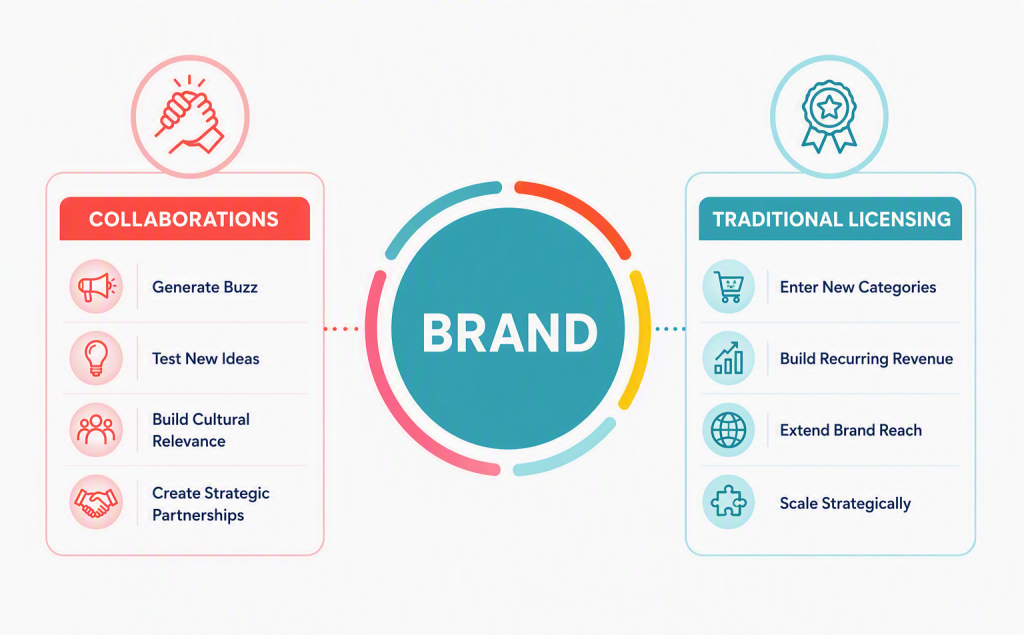
Generate Awareness and Excitement
Collaborations can create immediate attention and social conversation, particularly when two brands have highly engaged audiences.
For example, Duluth Trading has used strategic brand collaborations to extend its reach beyond traditional advertising, creating unique consumer experiences that generated excitement among both existing customers and new audiences. By partnering with nostalgic Hasbro brands like Tinker Toys and Lincoln Logs, the collaboration helped reinforce Duluth’s distinct personality while creating conversation and engagement that a traditional product launch alone would be unlikely to achieve.
Test New Ideas
A limited-edition collaboration can serve as a relatively low-risk way to explore a new category, audience, or product concept before making a larger investment.
Build Cultural Relevance
Many brands use collaborations to stay current, connect with emerging consumer interests, or participate in larger cultural conversations.
Create Strategic Partnerships
The best collaborations often introduce brands to new relationships that can lead to broader commercial opportunities over time.
In these situations, the primary goal isn’t necessarily long-term royalty generation. The objective is often visibility, engagement, learning, or strategic positioning.
What Is Traditional Licensing?
Traditional licensing allows a brand owner to authorize another company to create and sell products using its intellectual property in exchange for royalties and other financial considerations.
Licensing is often a long-term growth strategy. Unlike collaborations, licensing programs are typically designed to be scalable and sustainable over time.
A successful licensing program requires careful partner selection, clear brand standards, robust contracts, and ongoing portfolio management to ensure the brand continues to grow in the right direction.
When Traditional Licensing Makes Sense
Licensing typically becomes the better choice when a brand is seeking sustainable growth.
Entering New Categories
Licensing allows brands to expand into categories where they may lack manufacturing expertise, retailer relationships, or operational capabilities.
Take, for example, IMC’s long-standing program with Sweet Baby Rays and Bridgford Foods as an example of this approach in action. Rather than manufacturing and distributing jerky themselves, the brand leveraged a licensing partner with category expertise, production capabilities, and retail relationships, allowing Sweet Baby Ray’s to extend into a complementary category while remaining focused on its core business.
Building Recurring Revenue
Unlike one-time collaborations, licensing programs are designed to generate ongoing revenue through royalties and long-term partnerships.
Extending Brand Reach
A well-managed licensing portfolio can extend a brand’s presence across multiple consumer touchpoints and channels.
Scaling Strategically
Licensing provides a framework for growth that can be measured, optimized, and expanded over time.
When brands are focused on category expansion, portfolio development, or long-term value creation, licensing is often the more effective model.
The Most Strategic Brands Use Both
Increasingly, the highest-performing brands are not choosing one approach over the other. They’re using collaborations and licensing as complementary tools.
A collaboration can help validate consumer interest, test a market opportunity, or establish a new relationship.
A licensing program can then provide the structure and scalability needed to turn that opportunity into a long-term growth platform.
For example, a collaboration may reveal strong demand within an adjacent category. Rather than treating the initiative as a one-off success, a brand can use those insights to develop a broader category strategy and pursue licensing opportunities that deliver sustained growth.
Questions Every Brand Should Ask
Before pursuing either approach, leadership teams should ask:
- What business problem are we trying to solve?
- Is the goal awareness, revenue, category expansion, or audience growth?
- Does this opportunity strengthen our brand or simply create short-term attention?
- Is this a one-time initiative or part of a larger strategy?
- What capabilities do we need to execute successfully?
The answers will often make the right path clear.
Moving Beyond the Deal
Too often, brands evaluate opportunities based solely on excitement or financial upside. The more important question is whether an opportunity advances the broader business strategy.
The strongest growth doesn’t come from doing more deals—it comes from pursuing the right opportunities with the right structure behind them.
Whether through collaboration, licensing, or a combination of both, successful brands take a deliberate approach to evaluating opportunities, aligning them to business goals, and creating value that extends beyond the initial launch.
Because in today’s marketplace, the opportunity isn’t just finding a partner. It’s building the right ecosystem for growth, and that’s where a strategic brand licensing agency like IMC comes in.
Interested in learning more about IMC’s approach to brand licensing? Contact Us